

UAE pay rule explained: What’s the new private sector salary deadline from June 1?
Fresh wage framework aims to strengthen payroll compliance nationwide

DUBAI – The United Arab Emirates (UAE) is introducing a major change to how salaries are paid in the private sector, setting a single monthly payment deadline for companies across the country.
Beginning June 1, 2026, employers will be expected to transfer worker salaries on a fixed schedule under updated Wage Protection System (WPS) rules issued by the Ministry of Human Resources and Emiratisation (MOHRE).
The move marks one of the most significant updates to salary compliance regulations in recent years. Authorities have also attached a strict timeline of penalties for companies that delay wages, with measures escalating from electronic alerts and permit suspensions to legal proceedings and travel restrictions in serious cases.
Learn more about the latest amendments to the Wage Protection System in the UAE. Effective from 1 June, aimed at enhancing transparency and compliance across the private sector, reducing labour disputes, and supporting labour market stability and a more efficient business… pic.twitter.com/nFUFObAQYp
— وزارة الموارد البشرية والتوطين (@MOHRE_UAE) May 19, 2026
Issued under Ministerial Resolution No. 340 of 2026, the new framework aims to tighten labour oversight while creating a clearer payment structure for both employers and employees.
New deadline
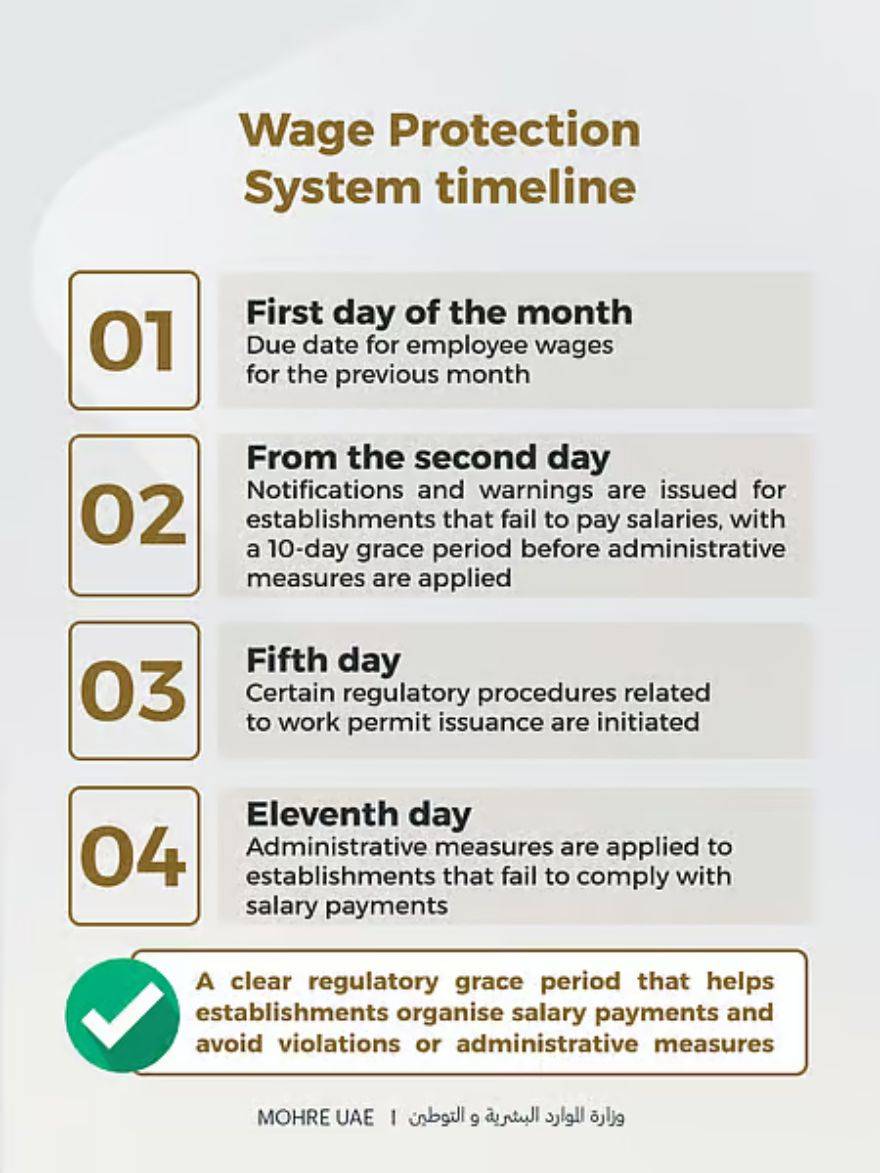
Under the revised system, all private sector companies registered with MOHRE must pay employee salaries on the first day of every Gregorian month for work completed during the previous month.
That means wages for May 2026, for example, would need to be transferred on June 1, 2026. Any payment made after that date will officially be considered delayed.
Salary payments must continue to be processed through the approved Wage Protection System or any other payment channels authorised by the ministry.
The ministry also stated that companies must provide supporting documents and data proving salary payments were completed according to approved procedures and regulations.
The introduction of a unified date removes variations in payment practices and introduces a single compliance benchmark across the private sector.
The 85% rule
One of the most closely watched elements of the new regulation is the introduction of an 85 percent payment threshold.
Under the resolution, a company can still be regarded as compliant if it transfers at least 85 percent of total wages owed to employees within the required timeframe.
Similarly, a worker will not automatically be considered unpaid if they receive at least 85 percent of their entitled salary, provided the remaining amount results from legally documented deductions or withholding permitted under UAE labour rules.
Examples could include approved deductions or circumstances already recognised under labour regulations.
However, the ministry clarified that employees still retain the right to pursue claims for any outstanding amount.
The threshold has been introduced to account for practical payroll scenarios while preserving worker rights and ensuring companies continue to meet core payment obligations.
Penalty timeline
The resolution sets out an escalating sequence of actions for companies that fail to meet the new salary deadline.
The process starts quickly.
From the second day after salaries become overdue, authorities will begin electronically monitoring companies and issuing warning notices and alerts to establishments that have failed to transfer wages.
If salaries remain unpaid by the fifth day after the deadline, more direct action follows. Employers may be prevented from obtaining new work permits and will receive formal notification explaining the violation and instructing them to settle outstanding wages.
The measures intensify further after the 11th day.
At that stage, companies could face administrative penalties under Cabinet Resolution No. 21 of 2020. Firms may also be downgraded to the third business classification category, with repeat violations within six months triggering additional action.
The ministry's approach effectively creates a countdown structure in which each missed stage brings a more serious response.
Day 16 action
The situation becomes considerably more serious if delays continue beyond the 16th day.
Authorities may automatically register labour disputes on behalf of affected workers. Depending on the circumstances, these could be individual or collective cases.
Further work permit suspensions may also be imposed.
The rule particularly applies to companies employing 25 workers or more and extends to businesses under the same ownership if the total number of affected employees reaches that threshold.
Authorities said special attention would also apply to sectors considered especially sensitive from a labour market perspective.
These include construction, transport and storage, security services, cleaning companies, recruitment agencies and domestic worker recruitment offices.
The inclusion of these sectors reflects the scale of workforce operations and the broader labour market impact delayed wages could create.
Tougher measures
The strictest phase begins on the 21st day after salary payments become overdue.
For establishments employing fewer than 50 workers, authorities may issue executive orders aimed at recovering unpaid wages.
Where companies employ 50 workers or more, authorities could begin collective labour dispute procedures.
Additional enforcement tools become available as well.
These may include precautionary asset seizure procedures, travel bans against responsible officials and notifications to government entities for further legal measures.
Repeated violations over two consecutive months may trigger referrals to Public Prosecution for companies employing more than 50 workers.
The rule also extends to multiple establishments owned by the same employer if the combined number of unpaid workers reaches the required threshold.
Authorities additionally noted they may intervene regardless of company size where delayed wages are considered a threat to labour market stability.
Who is exempt?
The resolution also outlines categories of workers and businesses that fall outside standard Wage Protection System calculations.
Workers involved in active labour disputes already referred to court, or cases where executive orders have already been issued, will be exempt for the disputed period and amount.
Employees reported absent from work are also excluded during the validity of such reports.
Workers unable to perform duties because of legal detention or court orders may also be exempt, along with employees on approved unpaid leave if companies submit the required documentation.
Additional exclusions include foreign employees of overseas entities paid outside the UAE and workers holding short-term permits lasting less than three months.
Entire sectors have also been exempted, including fishing boats, citizen-owned public taxis, banks, financial institutions and places of worship.
The ministry further clarified that employers may authorise third parties to process salary payments, although legal responsibility for ensuring wages arrive on time remains with the employer itself.